
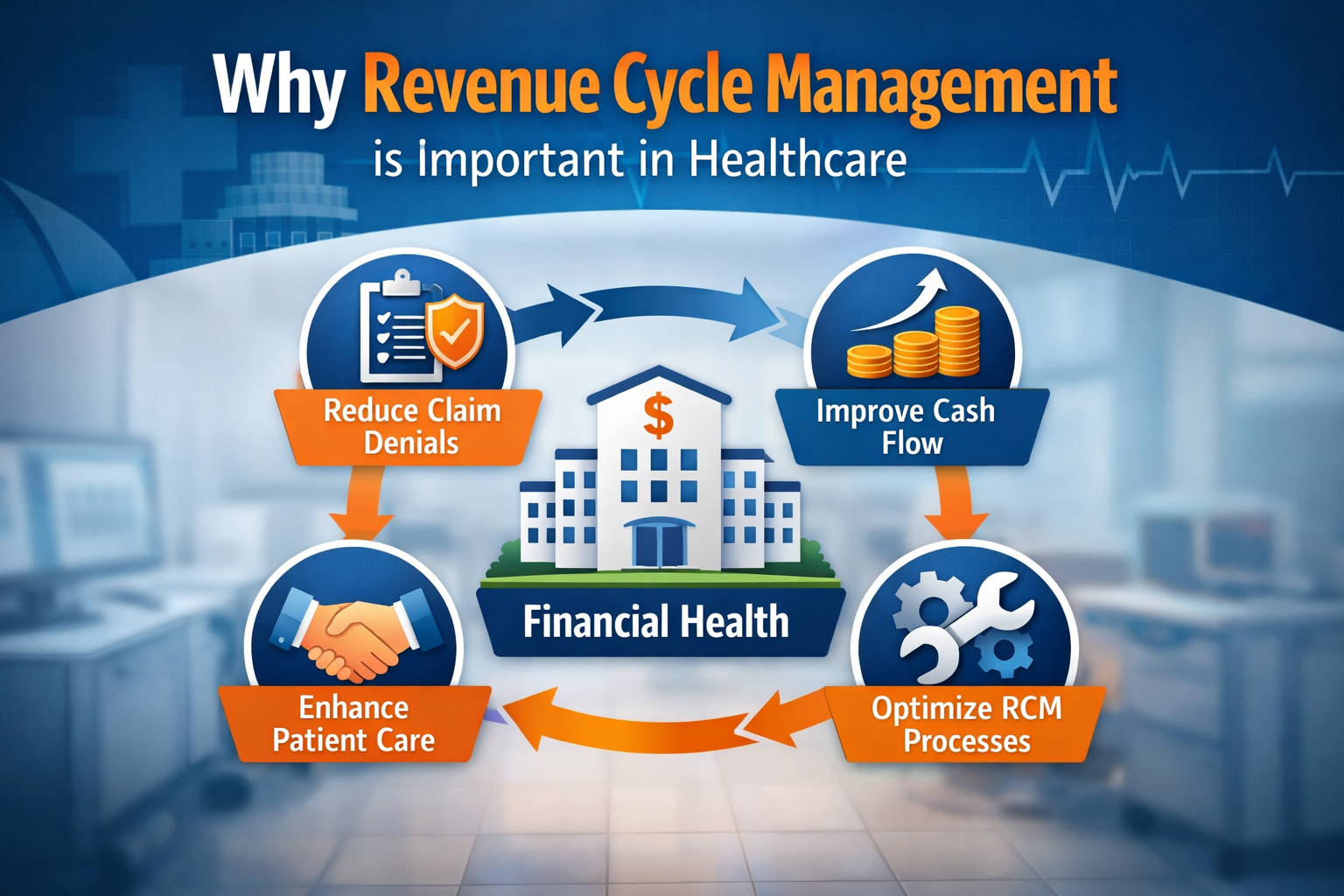
Revenue Cycle Management is more than just billing; it’s the backbone of a healthcare organization’s financial health, ensuring timely and accurate reimbursements for services rendered. In this blog, we’ll explore what Revenue Cycle Management (RCM) is, why it’s vital in healthcare, the financial benefits it brings, common challenges, and how technology and best practices can optimize your revenue cycle.
Working with a lot of healthcare providers, we have seen that nowadays, healthcare providers face increasing financial pressure due to rising claim rejections, denials, and expanding administrative requirements such as prior authorizations. Industry benchmarks show that the average initial claim rejection rate ranges between 10% and 15%, while the average claim denial rate across many healthcare organizations falls between 17% and 22%, with some practices experiencing even higher rates depending on payer mix and specialty. These challenges create significant administrative burdens and place substantial revenue at risk for healthcare organizations.
To illustrate the financial impact, consider a practice seeing 500 patients per month with an average reimbursement of $150 per visit. If every claim were paid correctly, the practice would generate approximately $75,000 in monthly revenue. However, with a 15% initial rejection rate and a 15% denial rate, roughly 139 claims per month may be rejected or denied, placing approximately $20,850 in monthly revenue at risk or more than $250,000 annually if those claims are not successfully corrected and recovered. This example highlights why strong Revenue Cycle Management systems are essential to reduce claim errors, manage denials effectively, and protect the financial health of healthcare practices.
What is Revenue Cycle Management in Healthcare?
Revenue Cycle Management (RCM), often referred to simply as medical billing, is actually a much broader process that encompasses all administrative and clinical functions involved in capturing, managing, and collecting healthcare revenue. While medical billing is one important component, true RCM spans the entire financial lifecycle of a patient encounter, from appointment scheduling, insurance verification, and patient registration to medical coding, claims submission, denial management, accounts receivable follow-up, patient collections, and financial reporting. By managing this full end-to-end revenue cycle effectively, healthcare organizations can reduce claim denials, improve cash flow, and ensure timely reimbursement for services provided.
The key steps include:
- Preregistration and Scheduling: Collecting patient demographics and verifying insurance coverage before the visit.
- Patient Registration: Confirming accurate patient and insurance information and collecting copayments, if applicable.
- Medical Coding and Charge Capture: Assigning standardized codes for diagnoses and procedures to create clean claims.
- Claims Submission: Sending accurate claims to insurance payers for reimbursement.
- Payment Posting & Patient Billing: Insurance payments are posted, and any remaining balance is billed to the patient.
- Denial Management: Identifying and resolving rejected claims to avoid revenue loss.
- Accounts Receivable Follow-up: Tracking unpaid balances and pursuing timely payment.
- Patient Collections: Billing patients for outstanding balances and facilitating payments.
- Reporting and Analytics: Monitoring performance metrics to improve processes.
Each step is interconnected; a problem in any phase can disrupt cash flow and reduce revenue.
Why is Revenue Cycle Management Important in the Healthcare Industry?
Effective RCM is essential because it:
- Ensures Accurate, Timely Reimbursement:Minimizing claim denials and delays helps healthcare providers get paid what they’re owed faster.
- Supports Regulatory Compliance:Proper coding, documentation, and billing safeguard against costly audits and penalties under HIPAA, CMS, and other regulations.
- Enhances Patient Experience:Transparent billing, insurance eligibility verification, and clear financial communication reduce patient confusion and build trust.
- Improves Operational Efficiency:Streamlining administrative workflows reduces overhead costs and administrative burden, allowing staff to focus more on patient care.
- Strengthens Financial Stability: Reliable revenue flow enables healthcare organizations to invest in quality care, technology, and growth.
Without effective revenue cycle management, practices risk significant revenue leakage, cash flow disruptions, and operational setbacks that can threaten their viability.
Financial Benefits of Effective Revenue Cycle Management
A well-managed revenue cycle directly impacts the financial health of healthcare organizations by:
- Reducing Revenue Leakage: Accurate coding and billing prevent lost income from denied or delayed claims.
- Improving Cash Flow:Faster claim approvals and patient payments stabilize finances.
- Lowering Administrative Costs:Automation and efficient workflows reduce the time and resources spent on billing and collections.
Success Snapshot – Mental Health IOP Practice in Spokane, WA
Challenge:
A Mental Health Intensive Outpatient Program (IOP) practice in Spokane faced nearly 10,000 unpaid claims due to nine months of incorrect billing across 10+ Medicaid Managed Care Organizations (MCOs).
Solution:
By leveraging deep expertise in State Medicaid and MCO billing requirements, the practice corrected submission errors and successfully resubmitted all backlogged claims within 45 days.
Result:
- $50,000 collected in month one
- $85,000 recovered in month two
- $110,000 recovered within 90 days
This turnaround restored cash flow and stabilized the practice’s revenue operations, illustrating how expert RCM interventions can transform financial outcomes.
Common Challenges in Healthcare Revenue Cycle Management
Despite its importance, managing the healthcare revenue cycle is complex, with challenges including:
- Coding and Billing Accuracy:Errors can cause claim denials and delayed payments.
- Claim Denials and Rejections:Resolving denials requires time, expertise, and follow-up.
- Credentialing and Insurance Verification: Ensuring providers are credentialed and insurance coverage is confirmed prevents claim rejections.
- Staffing and Training:High turnover and regulatory changes demand ongoing training and support.
- Regulatory Compliance: Navigating evolving healthcare laws and payer policies requires diligence.
- Patient Collections: Collecting patient balances sensitively and efficiently remains difficult.
Addressing these challenges proactively is key to maintaining a healthy revenue cycle.
Best Practices to Optimize Revenue Cycle Management
To maximize the benefits of RCM, healthcare organizations should:
- Implement Efficient Workflows:Ensure smooth coordination between front-end (registration, eligibility) and back-end (billing, collections) processes.
- Prioritize Staff Training:Keep teams updated on coding changes, payer requirements, and compliance.
- Use Data Analytics:Regularly track KPIs such as days in accounts receivable, denial rates, and clean claim rates to identify improvement areas.
- Engage an Experienced RCM Partner: Specialist partners bring expertise to optimize revenue flow and reduce risk.
For a deeper dive into building a strong operational foundation, check out our article on Healthcare Practice Management: The Structural Foundation Every Practice Needs to Survive and Scale.
Partner with Us for Expert Revenue Cycle Management
At L&C Advanced Practice Management, we specialize in helping healthcare organizations optimize their revenue cycle through tailored solutions. Explore our specialties and services designed to strengthen your financial health and operational efficiency: Our Focus Area.
Conclusion
Revenue Cycle Management is a vital function in the healthcare industry that directly impacts financial viability, regulatory compliance, and patient satisfaction. By understanding and optimizing each step of the revenue cycle, from patient registration to final payment, healthcare providers can reduce revenue leakage, improve cash flow, and focus more on delivering quality care.
If your organization is facing challenges with billing accuracy, claim denials, or collections, now is the time to evaluate and enhance your RCM processes. With the right strategies, technology, and expert partnerships, you can secure a stronger financial future while elevating patient experiences.
If you’d like help strengthening your revenue cycle management and improving your practice’s financial performance, schedule a call to learn more!
Frequently Asked Questions
Revenue Cycle Management (RCM) is important in the healthcare industry because it ensures healthcare providers receive accurate and timely reimbursement for the services they deliver. Without effective RCM processes, practices may experience claim denials, delayed payments, and revenue leakage. A strong revenue cycle system helps manage the entire financial lifecycle of patient care—from scheduling and insurance verification to billing, collections, and reporting—allowing healthcare organizations to maintain financial stability while continuing to provide high-quality patient care.
Effective revenue cycle management provides several key benefits, including improved cash flow, reduced claim denials, lower administrative costs, and better financial transparency. By optimizing RCM processes, healthcare organizations can minimize billing errors, accelerate reimbursement timelines, and gain better insights into financial performance. This allows providers to allocate more resources toward patient care and operational growth.
L&C Advanced Practice Management helps healthcare organizations optimize their revenue cycle by identifying inefficiencies, reducing claim denials, and improving reimbursement workflows. Through revenue diagnostics, operational analysis, and tailored RCM strategies, the team helps practices strengthen financial performance while maintaining compliance with healthcare regulations. Their expertise allows providers to streamline billing processes, recover lost revenue, and build a more resilient financial foundation for long-term growth.