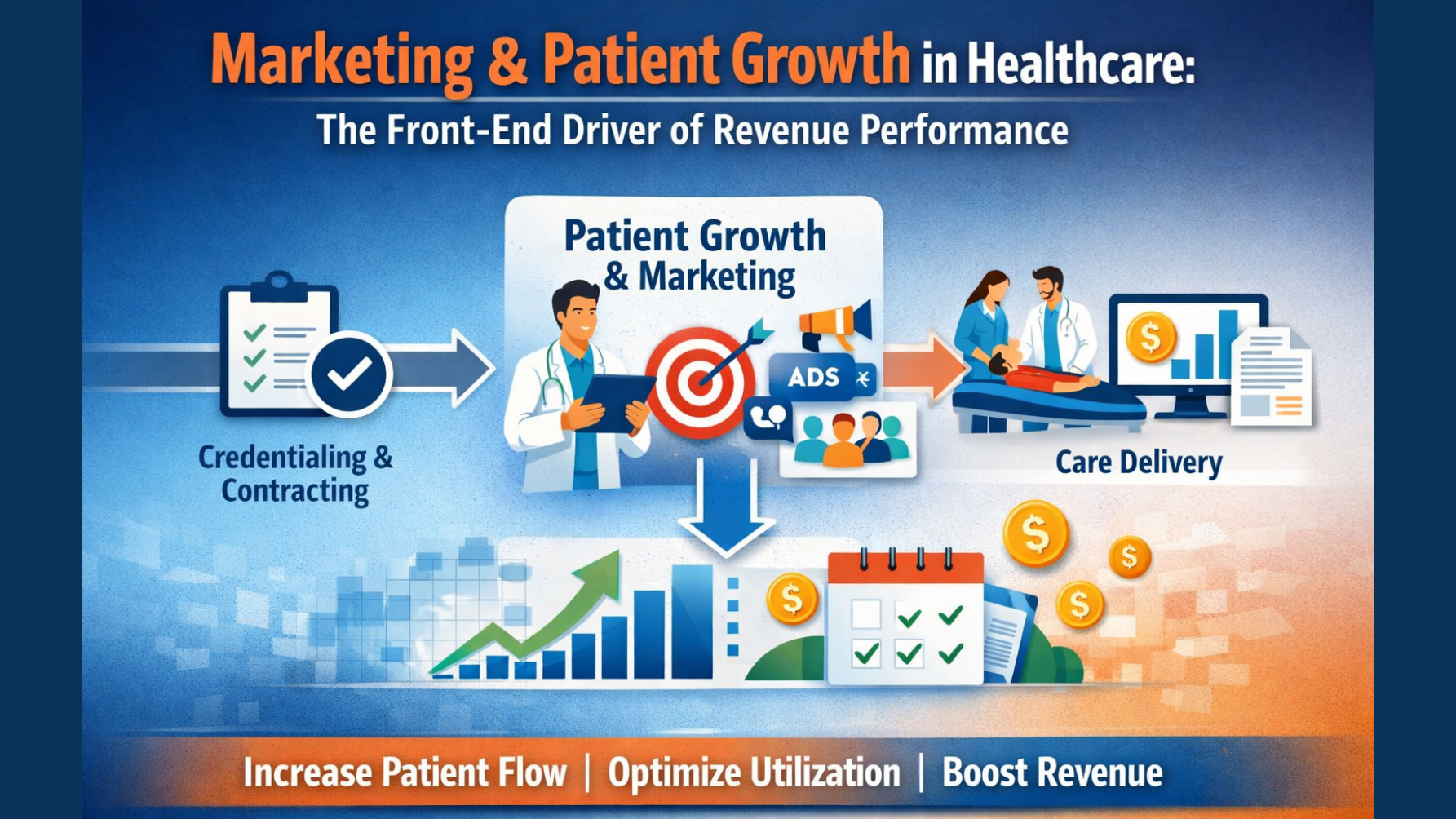
Healthcare marketing is not just about visibility; it is the front-end driver of revenue performance. Without structured patient growth (acquisition, conversion, and retention), even well-run clinical and billing operations will struggle with inconsistent revenue.
Aligning marketing with payer strategy, operational capacity, and conversion systems is essential to create predictable patient flow and sustainable financial outcomes.
Most healthcare organizations do not struggle because they lack clinical capability or billing infrastructure. They struggle because they lack a consistent, predictable patient flow.
Providers may have availability in their schedules, teams may be ready to deliver care, and billing processes may be functioning effectively, yet revenue remains inconsistent or below expectations. In many cases, the issue is not what happens after a patient visit, but what happens before it.
Patient growth is often treated as a marketing problem, but in reality, it is an operational and financial issue. It determines whether providers are fully utilized, whether schedules are consistently filled, and whether revenue opportunities are captured or missed.
Without a structured approach to generating and converting patient demand, healthcare organizations often experience:
- Uneven scheduling patterns
- Last-minute cancellations and no-shows
- Underutilized provider capacity
- Unpredictable revenue performance
Marketing, when viewed correctly, is not simply about visibility or promotion. It is the mechanism through which patient demand is created, guided, and converted into actual visits.
Patient growth, therefore, is not about increasing volume at random. It is about building a controlled and reliable flow of patients that aligns with payer participation, operational capacity, and reimbursement structure.
When this alignment is missing, organizations may generate activity without generating meaningful revenue.
Understanding how marketing and patient growth function as the front-end driver of revenue performance is essential for healthcare practices seeking to stabilize volume, improve efficiency, and strengthen financial outcomes.
Where Marketing and Patient Growth Fit in the Revenue Process
To understand the true role of marketing in healthcare, it is important to recognize when patient growth should occur within the broader revenue process.
Before a healthcare organization invests heavily in marketing and patient acquisition, it must first ensure that:
- Providers are properly credentialed with target payers
- Payer contracts are established and aligned with services offered
- Reimbursement structures support financial sustainability
Once these elements are in place or at minimum actively in progress, marketing and patient growth efforts can begin to scale.
If marketing occurs too early, before payer alignment is established, organizations may attract patients whose services cannot be reimbursed appropriately.
This can result in:
- Out-of-network claims
- Reduced reimbursement
- Claim denials
- Administrative rework
- Lost revenue
For this reason, marketing and patient growth should be positioned:
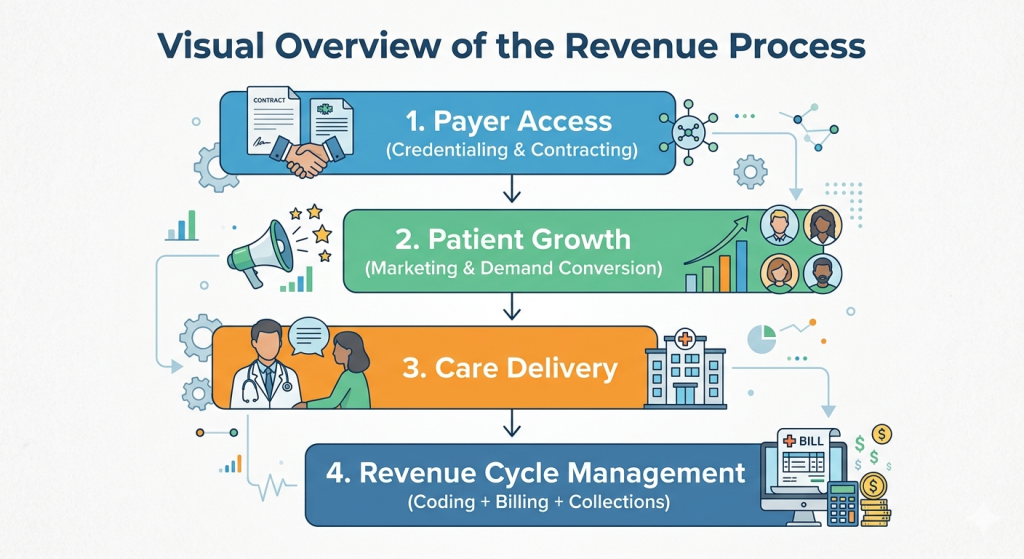
After credentialing and contracting are established (or in parallel with the final stages of payer enrollment). Before revenue cycle processes begin. At this stage, patient demand can be generated in a way that aligns with both payer participation and operational capacity, allowing downstream billing processes to function effectively.
What Is Patient Growth in Healthcare?
Patient growth refers to the ability of a healthcare organization to consistently attract, convert, and retain patients within its care delivery system.
It includes three primary components:
- Patient acquisition (bringing new patients into the practice)
- Patient conversion (turning interest into scheduled visits)
- Patient retention (ensuring ongoing engagement and repeat visits)
While marketing activities support patient growth, growth itself is an operational outcome, not just a marketing effort.
Why Patient Growth Is a Direct Driver of Revenue
Revenue in healthcare is fundamentally tied to patient encounters.
No matter how strong a practice’s billing processes are, revenue cannot be generated without patients entering the system.
A common scenario occurs when a practice focuses heavily on improving billing efficiency while neglecting patient acquisition.
In this situation:
- Claims may be processed correctly
- Reimbursement may be optimized
- Operational workflows may be efficient
Yet overall revenue remains stagnant due to insufficient patient volume.
Conversely, practices that generate high patient demand without proper operational alignment may experience:
- Scheduling bottlenecks
- Long wait times
- Patient dissatisfaction
- Missed revenue opportunities
Patient growth is not simply about increasing volume. It must occur within the right timing and structure, after payer access is established and before revenue cycle processes begin, so that each patient encounter can translate into reimbursable revenue.
The Difference Between Marketing and Patient Growth
Many healthcare organizations equate marketing with:
- Social media posts
- Website updates
- General advertising
While these activities may create awareness, they do not necessarily result in patient growth.
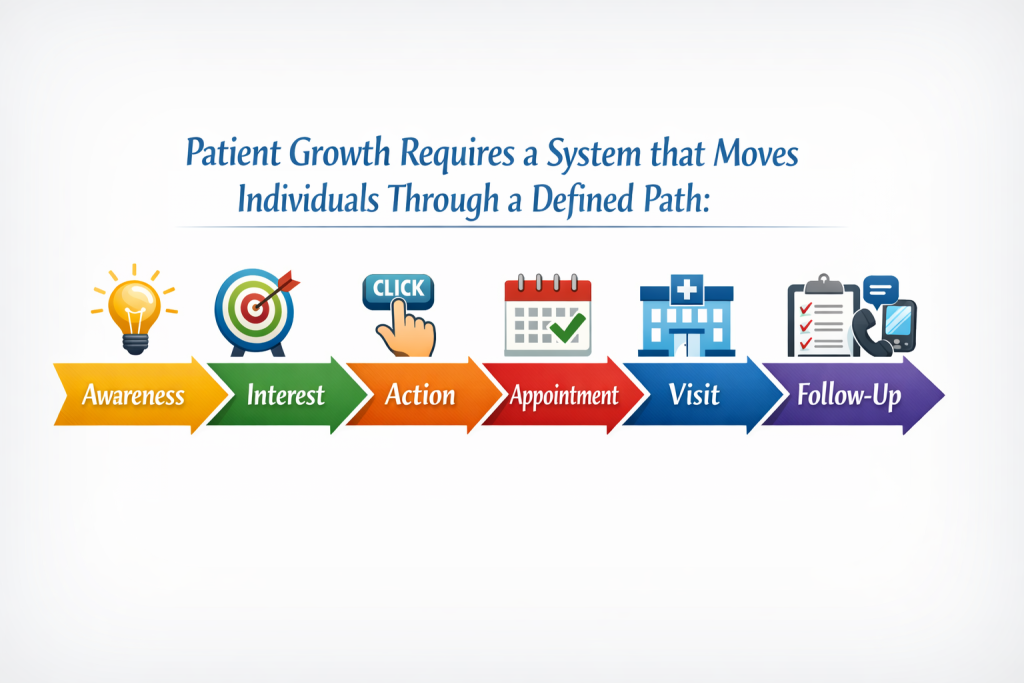
Without this structure, marketing efforts may generate attention without generating revenue.
Patient Acquisition: Generating Qualified Demand
Patient acquisition is the process of attracting individuals who are both:
- In need of services
- Aligned with the practice’s payer and service structure
Effective patient acquisition channels include:
- Physician referrals
- Digital advertising
- Search engine visibility
- Community outreach
- Payer directory positioning
Operational Challenges in Patient Acquisition
Unqualified Demand
Not all patient demand is valuable.
For example:
- Patients may not have accepted insurance
- Services requested may not be offered
- Patients may not meet clinical criteria
This results in:
- Wasted administrative time
- Scheduling inefficiencies
- Lower conversion rates
Misalignment with Payer Mix
If marketing efforts attract patients outside of the practice’s payer network:
- Services may be out-of-network
- Reimbursement may be reduced
- Claims may be denied
Patient acquisition must therefore align with credentialing and contracting strategy.
Patient Conversion: Turning Demand Into Scheduled Visits
Generating interest is only the first step. Patient conversion determines whether that interest becomes revenue.
Conversion includes:
- Answering calls
- Responding to inquiries
- Scheduling appointments
- Guiding patients through intake
Where Conversion Breaks Down
Slow Response Time
If patient inquiries are not handled quickly:
- Patients may choose another provider
- Demand is lost before conversion
Poor Call Handling
Front-desk interactions significantly impact conversion.
If staff:
- Lack of clarity on services
- Cannot verify insurance
- Fail to guide patients
Conversion rates decline.
Complex Scheduling Processes
If scheduling is difficult:
- Patients may abandon the process
- No-shows may increase
Conversion is an operational function, not just a marketing outcome.
Patient Retention: Sustaining Revenue Over Time
Patient retention ensures that individuals continue receiving care when appropriate.
Retention impacts:
- Repeat visits
- Treatment adherence
- Long-term revenue
Retention Failures
Poor Follow-Up Processes
If patients are not guided into follow-up care:
- Visits may not continue
- Revenue opportunities are lost
No Continuity of Care
If care plans are not clearly communicated:
- Patients disengage
- Retention declines
Lack of Engagement Systems
Without reminders, outreach, or structured communication:
- Patients may not return
- No-shows may increase
Retention is often one of the most overlooked drivers of revenue stability.
Patient Flow: From Demand to Revenue
Patient growth is not just about generating demand. It is about managing patient flow through the organization.
This includes:
- How patients enter the system
- How quickly are they scheduled
- How efficiently visits occur
- How consistently they return
Breakdowns in patient flow result in:
- Unused provider capacity
- Gaps in scheduling
- Inconsistent revenue
Marketing Without Operational Alignment
One of the most common issues in healthcare organizations is misalignment between marketing and operations.
Examples include:
- Marketing campaigns that generate demand without scheduling capacity
- Attracting patients outside of payer networks
- Generating leads without conversion processes
In these cases, marketing activity increases, but revenue does not.
The Connection Between Patient Growth and Revenue Performance
Patient growth directly influences:
- Visit volume
- Provider utilization
- Revenue per day
- Overall financial performance
However, growth must be aligned with:
- Credentialing and contracting
- Operational capacity
- Billing processes
Without alignment, growth can create inefficiencies instead of improvement.
Transition to Revenue Cycle Management
Once patient demand is generated, patients are scheduled, and services are delivered, the organization enters the next phase of the revenue process.
At this point, Revenue Cycle Management becomes responsible for executing the financial components of care delivery, including claims submission, denial management, and collections.
However, it is important to recognize that revenue cycle performance is heavily influenced by what occurs upstream.
If patient growth is misaligned with payer participation, or if demand is generated without proper operational structure, revenue cycle processes will be forced to compensate for issues they did not create.
This often results in:
- Increased denial rates
- Delayed reimbursement
- Higher administrative workload
When marketing, patient growth, and payer alignment are properly structured, Revenue Cycle Management can operate within a stable and predictable environment.
For a deeper discussion, refer to: Revenue Cycle Management in Healthcare
Visual Overview of the Revenue Process
Why Patient Growth Must Be Structured
Healthcare organizations that rely on inconsistent or passive marketing efforts often experience:
- Fluctuating patient volume
- Unpredictable revenue
- Operational inefficiencies
Structured patient growth creates:
- Predictable demand
- Consistent scheduling
- Stable revenue
Strengthening Marketing and Patient Growth
Healthcare organizations can improve patient growth by:
Aligning Marketing With Payer Strategy
Target patients within accepted insurance networks.
Improving Conversion Processes
Ensure rapid response and efficient scheduling.
Implementing Follow-Up Systems
Guide patients through ongoing care.
Monitoring Performance Metrics
Track:
- Conversion rates
- No-Show rates
- Patient retention
Key Takeaways
- Patient growth is an operational and financial function, not just marketing
- Revenue depends on consistent patient flow, not just billing efficiency
- Marketing must align with payer contracts and reimbursement structures
- Patient growth consists of:
- Acquisition (bringing patients in)
- Conversion (turning interest into visits)
- Retention (keeping patients engaged)
- Poor alignment leads to:
- Denials
- Lost revenue
- Scheduling inefficiencies
- Conversion failures (slow response, poor call handling) directly reduce revenue
- Retention is one of the most overlooked revenue drivers
- Structured patient flow = predictable revenue + optimized provider utilization
Final Thoughts
Marketing and patient growth are not separate from revenue performance, they are foundational to it.
They determine:
- How many patients enter the system
- How consistently services are delivered
- How stable revenue becomes
Healthcare organizations that treat marketing as a structured, operational function, rather than a passive activity, are better positioned to improve financial outcomes.
Evaluating Your Patient Growth Strategy
If your organization is experiencing inconsistent patient volume, underutilized providers, or unpredictable revenue, it may be time to evaluate your patient growth strategy.
L&C Advanced Practice Management works with healthcare organizations to assess patient flow, improve conversion processes, and align growth strategies with revenue performance.
To learn more, schedule a consultation with our team.
Frequently Asked Question
Patient growth is the process of attracting, converting, and retaining patients within a healthcare system to ensure consistent care delivery and revenue generation.
Marketing creates patient demand, which directly impacts visit volume. Without patients entering the system, revenue cannot be generated regardless of billing efficiency.
Marketing creates awareness, while patient growth is a structured system that moves patients from awareness to appointment, visit, and follow-up.
L&C Advanced Practice Management helps healthcare organizations build a structured patient growth system by aligning marketing, patient acquisition, conversion processes, and operational workflows with payer strategy and revenue goals. They identify gaps in patient flow, improve scheduling and front-desk conversion, and ensure that patient demand translates into consistent, reimbursable revenue, leading to better provider utilization and predictable financial performance.